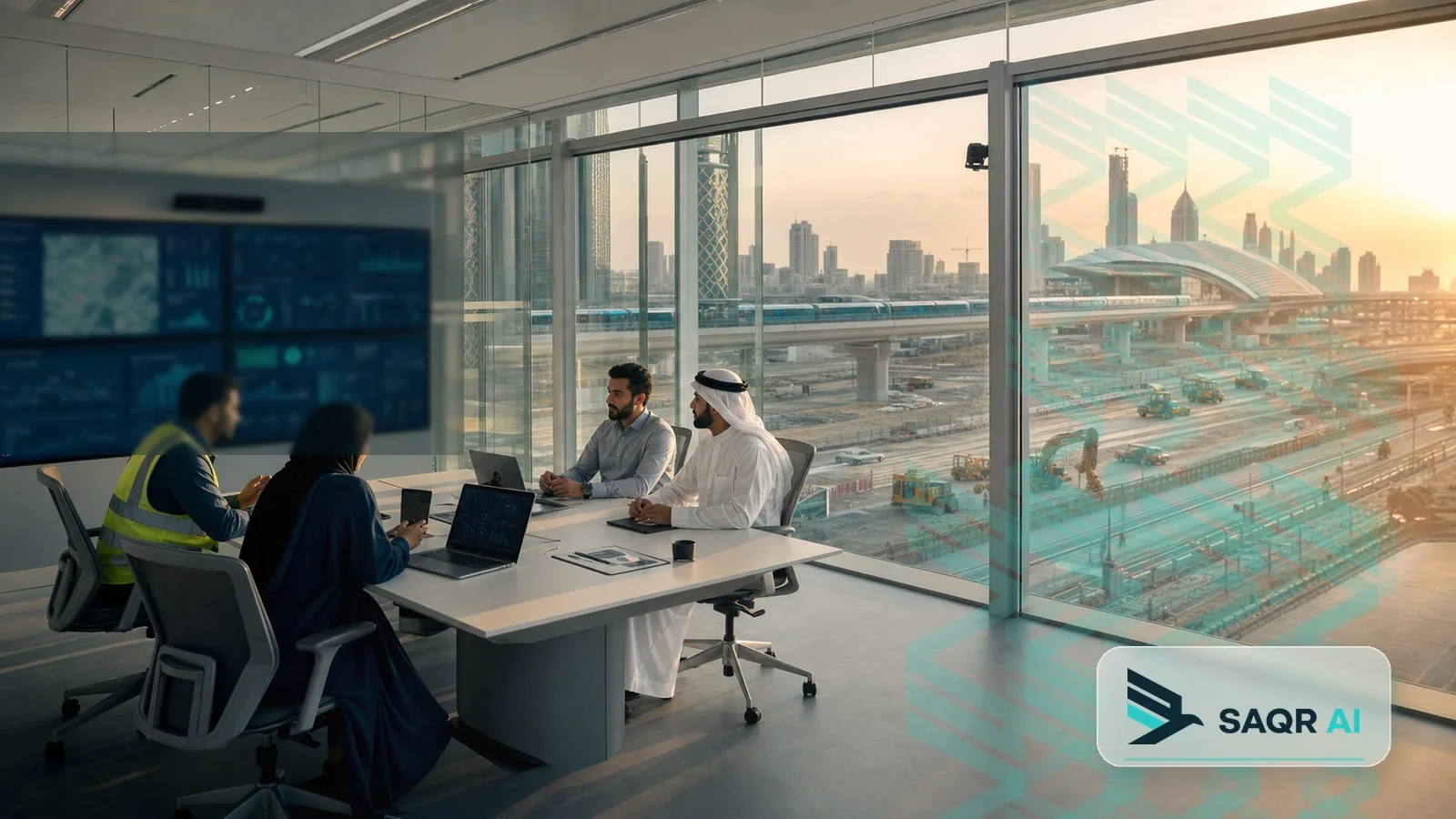
Why SAQR AI Is an Ecosystem, Not a Single Product
Many AI companies start with one product.
One interface. One model. One pilot. One presentation for a customer.
That approach may be understandable at the first stage, but in a real operational environment it quickly reaches a limit: the customer's problem almost never lives inside one product.
On an infrastructure site, it is not enough to simply “see” an event. The system has to understand what the event means, who should respond, how it is connected to equipment, shifts, safety, KPIs, people and management decisions.
In healthcare, it is not enough to build an AI model. It has to be embedded into the clinical workflow, keep the physician in control, support local operation and make sure the technology helps instead of interrupting the process.
In education, it is not enough to deliver a course. Competence has to be transferred to the people who will continue working with new tools after the pilot is over.
This is why SAQR AI is being built not as a single product, but as an applied AI ecosystem.
What we mean by ecosystem
For us, an ecosystem is not a collection of logos and not a marketing structure.
The SAQR AI ecosystem is an implementation architecture where each product is responsible for a specific layer of the operational problem.
SAQR AI is the engineering core. It is the master brand that brings together methodology, product architecture, applied AI, system integration and implementation discipline.
SAQR EDGE is responsible for machine vision, edge AI, cameras, events, analytics and response on site.
BIS-ON is responsible for equipment, shifts, downtime, productivity, KPIs and the production cycle.
SAQR ACADEMY is responsible for transferring competence to people: managers, engineers, operators, dispatchers, students, teachers and customer teams.
SAQR MED develops a separate medical vertical where computer vision and AI must work inside the clinical process, on the side of the medical organization and under the control of the physician.
This approach is necessary because the real value of AI does not appear at the moment when a model is demonstrated. It appears when technology is embedded into a process, understood by people, connected to management and able to produce a measurable result.
Why one product does not solve an operational problem
An operational problem is rarely simple.
For example, cameras can be installed on an infrastructure site. But cameras by themselves do not manage the site.
GPS can be installed on equipment. But GPS alone does not explain why equipment is idle, how the shift is being used, where productivity is being lost and who must make the decision.
Data can be collected. But data does not create value if it does not lead to action.
Training can be delivered. But training does not work if people return to an old process where there is no new role, no new discipline and no new responsibility.
That is why SAQR AI looks at implementation more broadly.
We do not start with the question “which AI model should we install?”. We start with the question “which event, decision or process must become manageable?”.
This is a fundamental difference.
If the task is only object detection, the result is a picture with a box.
If the task is event management, the result must be a clear operational loop: event, priority, responsible person, action, control, reporting and KPI.
This is where the logic of the ecosystem appears.
SAQR EDGE: from video stream to event
SAQR EDGE is responsible for the layer of observation, analysis and response on site.
It is not just video surveillance. Video surveillance shows an image. SAQR EDGE is designed to help turn video streams into events, and events into management actions.
At the core of SAQR EDGE is a combination of:
- stationary cameras and site infrastructure;
- edge AI and local processing;
- event detection;
- classification and prioritization;
- notifications and response;
- reports and analytics;
- integration into customer processes.
For infrastructure and industrial projects, this is especially important.
A site may have dozens of cameras, several contractors, different zones of responsibility, limited connectivity and a high risk of attention loss. If a system only stores video, it helps investigate the past. If a system captures an event and starts a response, it helps manage the present.
SAQR EDGE is built for this transition: from observation to event management.
BIS-ON: equipment management is not GPS
BIS-ON is responsible for another layer: the production cycle of equipment.
In infrastructure projects, equipment is one of the key resources. Dump trucks, excavators, bulldozers, loaders, rollers and other machines shape the rhythm of work, the cost of a shift and actual productivity.
But equipment management cannot be reduced to coordinates.
GPS answers the question “where is the machine?”. For management, that is not enough.
An operations manager needs to understand:
- what the equipment was supposed to do during the shift;
- what it actually did;
- where downtime appeared;
- why downtime appeared;
- who is responsible for removing the cause;
- how productivity is changing;
- how equipment is connected with the plan, people, materials and work front.
In the international SAQR AI architecture, BIS-ON is responsible for this layer: equipment, shift, downtime, plan versus fact, KPIs and management discipline.
Its task is not just to collect data. Its task is to help see where the production cycle loses efficiency and turn this into a manageable action.
SAQR ACADEMY: technology does not work without people
Even the strongest technology does not create results if people do not understand how to work with it.
SAQR ACADEMY is responsible for the competence transfer layer.
This is not a secondary direction. For applied AI, it is a critical part of implementation.
Cameras can be installed. But who will interpret events correctly?
An equipment management system can be implemented. But who will change shift discipline, work with the causes of downtime and make decisions based on data?
A medical AI model can be built. But how will it be embedded into the clinical workflow, and how will the physician use its result?
SAQR ACADEMY answers these questions through a methodology of training and development:
- programs for managers and engineering teams;
- training for operators, dispatchers and users;
- digital classrooms and simulators;
- practical cases;
- mentoring;
- competence maps;
- individual development paths;
- preparation of national talent for infrastructure projects.
Experience in Kyrgyzstan has shown that SAQR ACADEMY can work not only as an educational product, but also as a model connecting a university, students, teachers, companies and a practical production module.
This matters for MENA and Central Asia because the region needs not only technology. It needs teams that can apply, support and develop these technologies inside their own organizations.
SAQR MED: medical AI must work inside the clinic
SAQR MED is a separate medical vertical of SAQR AI.
Its logic differs from the industrial direction, but the principle remains the same: AI must be embedded into a real process.
In healthcare, AI cannot be treated as an external “demo tool”. A physician works with the patient, data, images, clinical context, time constraints and responsibility for the decision.
That is why SAQR MED is being developed as computer vision for medical images that should support the clinical workflow rather than replace the physician.
The first focus of SAQR MED is connected with MRI/CT analysis and the detection of focal pathologies, including the liver model as the first release. Further development may include other anatomical areas, but the principle remains the same: local operation, physician control, clear integration and decision support.
For MENA, this is especially important.
Medical organizations need solutions that can work inside their infrastructure, respect data requirements and remain understandable for physicians. SAQR MED is built around this logic.
The common principle: manageable is more important than observable
SAQR AI has a common methodological principle: to turn what is observable into what is manageable.
A video stream can be observed. But the important thing is to manage the event.
The location of equipment can be seen. But the important thing is to manage the production cycle.
Data can be available. But the important thing is to make decisions.
Training can be delivered. But the important thing is for competence to remain inside the team.
An AI model can be built. But the important thing is for it to work inside a real process.
This is why SAQR AI builds an ecosystem rather than a single product.
Each product covers its own layer, but together they form a common implementation architecture:
- SAQR EDGE sees and captures events;
- BIS-ON helps manage equipment and the production cycle;
- SAQR ACADEMY transfers competence to people;
- SAQR MED develops medical AI inside the clinical workflow;
- SAQR AI connects these directions into one engineering and methodological system.
Why this matters for MENA and Central Asia
MENA and Central Asia are in a phase of active development across infrastructure, industry, logistics, healthcare and digital government programs.
In such conditions, the market does not need another AI demonstration for the sake of demonstration.
The market needs implementations that can be tested on site, adapted to local conditions and scaled after a pilot.
This creates several practical requirements:
- technology must work in a real operational environment;
- the solution must account for connectivity, safety, data and local infrastructure;
- the pilot must have clear metrics;
- the customer's team must understand how to use the result;
- after implementation, competence must remain inside the organization;
- the product must become part of the process, not a separate screen.
SAQR AI is being built for exactly this task.
We do not want to be a company that only shows AI presentations.
We build an applied implementation architecture where AI must work on site, in a shift, in a clinic, in a training program and in the management loop.
From pilot to scale
The ecosystem approach is especially important at the pilot stage.
A pilot must not be a separate experiment that looks good in a report but does not change the process.
A proper pilot must answer several questions:
- which event or process do we want to make manageable;
- which data is needed to confirm the result;
- who will use the system;
- which actions must be triggered after the event;
- which KPIs show success;
- which conditions are required for scaling;
- which competencies must remain with the customer's team.
If there is no answer to these questions, the pilot becomes a demonstration.
If the answers exist, the pilot becomes the first step toward industrial implementation.
This is why SAQR AI products do not exist separately from each other. SAQR EDGE, BIS-ON, SAQR ACADEMY and SAQR MED help cover different sides of one task: to implement AI so that it becomes part of work.
What comes next
The next stage of our content series will focus on individual products and pilots.
We will show in more detail:
- how SAQR EDGE turns cameras into events and response;
- why BIS-ON looks at equipment through the production cycle, not only through GPS;
- how SAQR ACADEMY helps transfer competence to people;
- how SAQR MED builds medical AI inside the clinical workflow;
- how pilots should move from hypothesis testing to scalable implementation.
For us, this sequence matters.
First, explain the architecture.
Then show the products.
Then show pilots and results.
This is how trust is built: not through loud claims, but through clear methodology, real scenarios and consistent implementation.
SAQR AI is an applied AI ecosystem for tasks where technology must work not in a presentation, but in a real process.
SAQR AI website: http://saqr-ai.com/