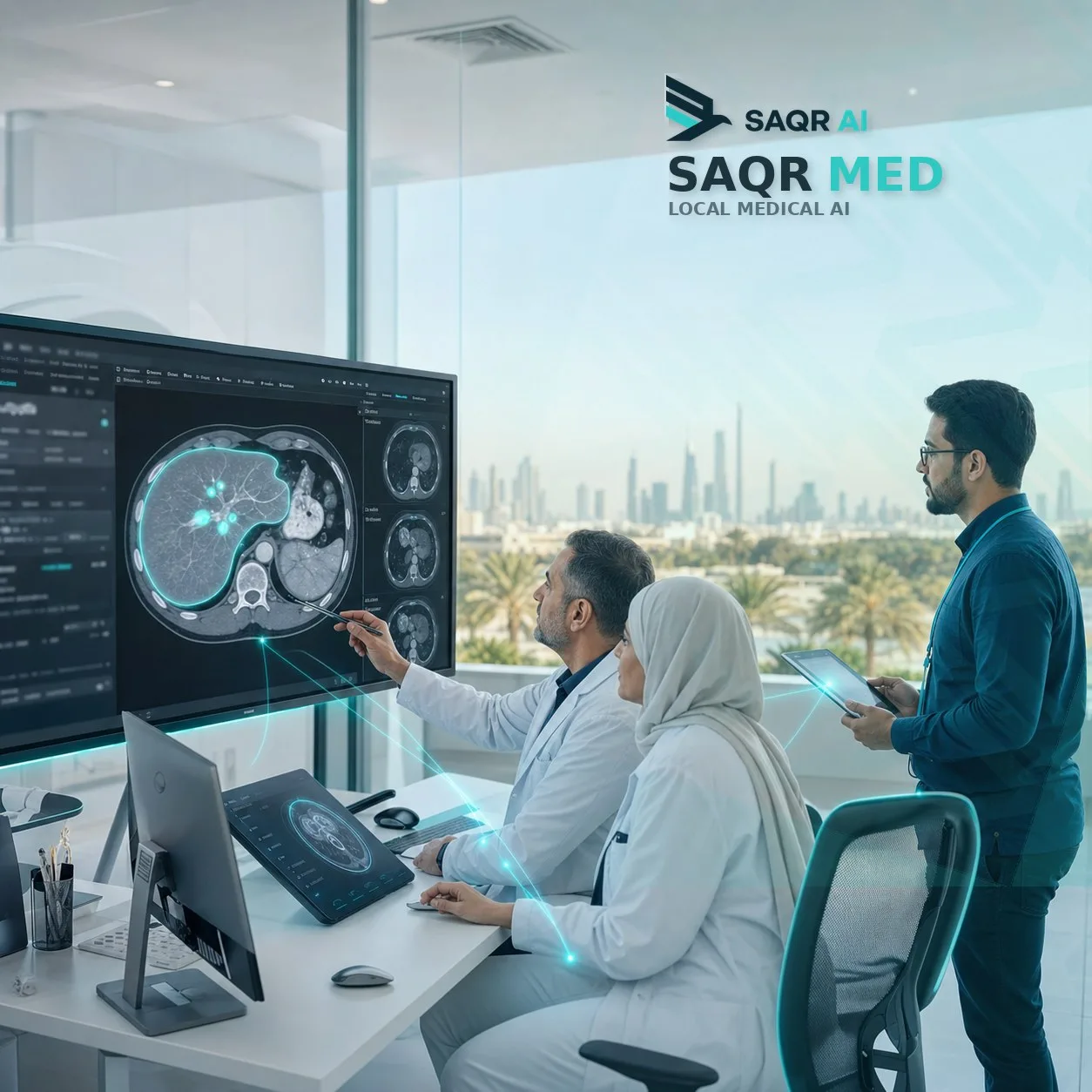
SAQR MED: Medical AI Should Work Inside the Clinic
When people talk about medical AI, they often focus on model accuracy. But for a real clinic, accuracy alone is not enough.
It also matters where the model runs, who controls the patient data, how the doctor understands the result, and what remains inside the clinic after implementation.
SAQR MED is built around this logic.
It is medical computer vision for MRI and CT analysis, helping clinical teams detect focal pathologies earlier and work with medical images in a more systematic way.
Why We Start With the Liver Model
We start with the liver model, because liver diagnostics is one of the areas where early detection of suspicious zones is especially important.
According to GLOBOCAN / IARC estimates for 2022, liver and intrahepatic bile duct cancer ranked seventh globally by number of new cases and third by cancer mortality: GLOBOCAN / IARC liver factsheet.
The SAQR MED Principle
The principle behind SAQR MED is broader than one organ or one model:
**A trained model.
Transferred to the customer.
Running locally.**
We do not say that AI replaces the doctor. That is the wrong and dangerous logic.
SAQR MED strengthens the doctor and the clinic: it helps clinical teams see more, keep control over their data, and develop internal medical AI competence.
Why Local Deployment Matters
For a clinic, data is not just a file. It is medical responsibility, patient trust, regulatory context and internal security.
That is why SAQR MED is not positioned as an external black box. The model should work inside the clinic’s own perimeter, supporting the clinical team while the organization keeps control of its data and processes.
For MENA and Central Asia, this approach is especially important. Medical AI should not be just an external cloud service. It should be local, understandable for doctors, and integrated into the real clinical workflow.
Website: saqr-ai.com
SAQR MED: saqr-med.com