SAQR ACADEMY: A Practical Education Model Tested in Kyrgyzstan
Infrastructure projects require more than equipment, software and digital platforms.
They require people who understand how a modern project site really works: how a shift is planned, how machinery is managed, how deviations are recorded, how data turns into management action, and how technology becomes part of everyday operational discipline.
This is the idea behind SAQR ACADEMY.
For us, SAQR ACADEMY is not an educational product separated from real work. It is the methodological layer of the SAQR AI ecosystem responsible for transferring competence to students, engineering teams, managers, operators, teachers and companies that will work with digital tools on real infrastructure projects.
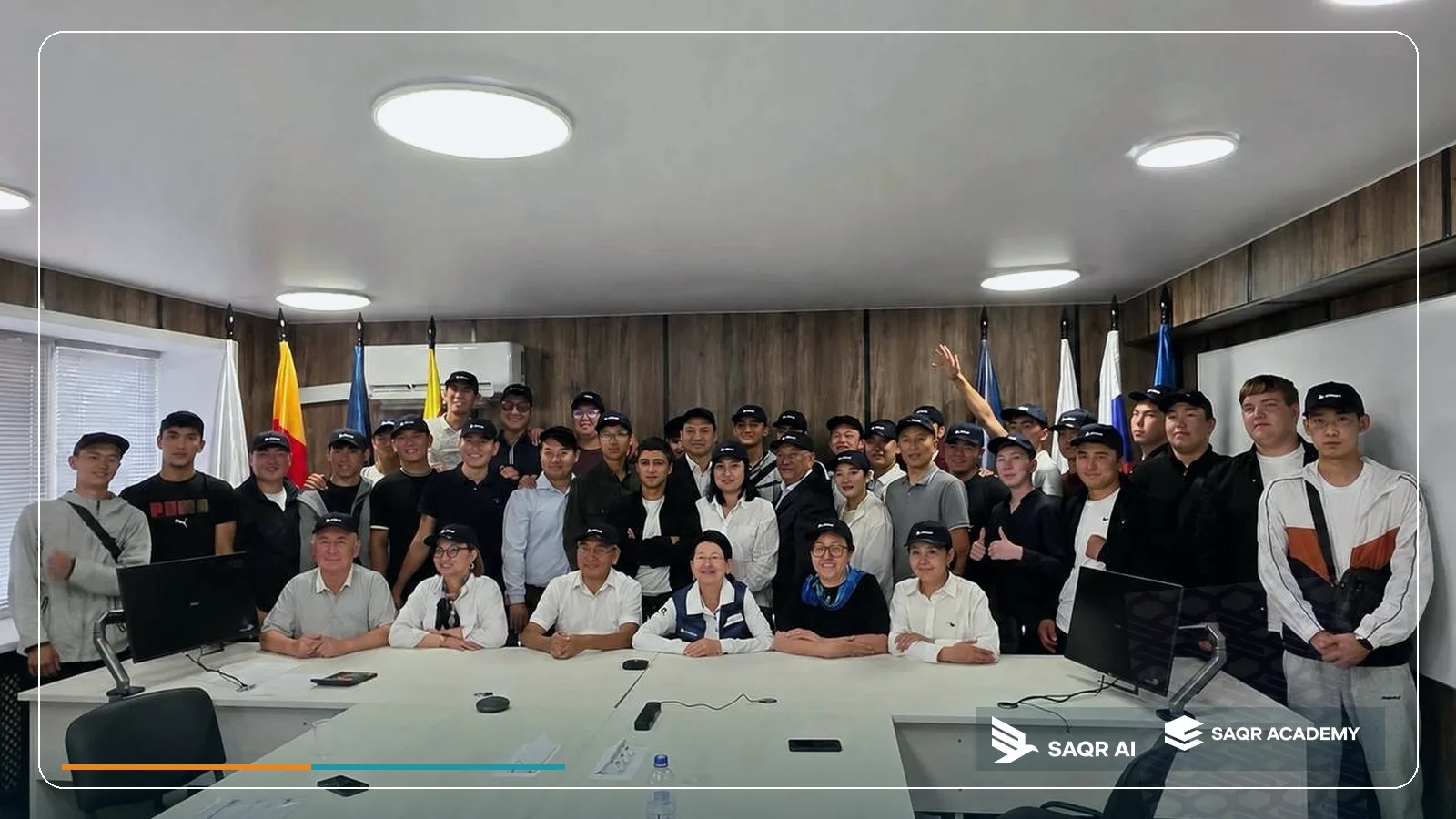
One of the first models of this approach was tested in Kyrgyzstan — not as a one-time lecture, but as a connection between a university, vocational institutions, students, teachers, companies and a practical production module.
At the core of this model is not only a training course, but also a corporate methodology for developing a talent reserve: competency maps, career tracks, readiness assessment, individual development plans, mentoring, practical assignments, review committees and regular adjustment of the program based on learning results.
Why Kyrgyzstan
Kyrgyzstan is at a point where infrastructure, education and digital transformation need to develop together.
The country needs specialists for roads, bridges, transport corridors, railway projects, energy, communications and digital systems. Academic education alone is no longer enough. The market needs people who understand not only theory, but also the real production logic of an infrastructure site.
Kyrgyz State Technical University named after I. Razzakov is already part of this agenda. The university has a specialized Department of Roads and Railways, Bridges and Tunnels, as well as initiatives connected with training specialists for road and railway infrastructure (KSTU).
KSTU also has a digital education foundation: the university participated in the Erasmus+ ELBA project focused on creating educational and research centers and developing courses in big data analytics in Central Asia (Bilim AKIpress).
This context matters. SAQR ACADEMY does not enter an empty field. The model should strengthen the existing educational and infrastructure agenda of the country.
What We Wanted to Test
The key question was not whether it was possible to hold lectures.
Lectures can almost always be organized.
The real question was different:
Can a university, students, companies, a practical production base and a clear competency development system be connected into one working model for preparing talent for infrastructure projects?
We were testing not a presentation format, but a model:
- how students perceive applied methodology;
- how education can be connected with real tasks of the infrastructure sector;
- how to explain the production cycle, machinery, data and management in simple language;
- how to involve companies that need prepared talent;
- how to make sure training does not end with a certificate, but turns into practical competence;
- how to build a path from first contact with the industry to a conscious professional trajectory.
What the Model Included
The SAQR ACADEMY model for Kyrgyzstan was built around five elements.
The University
KSTU became the academic entry point.
This is important because a sustainable talent model cannot be built only around an external course. It must be connected with a university, teachers, learning tracks and long-term student development.
Students
Students had the opportunity to see infrastructure not as a set of academic disciplines, but as a living production system.
This system includes machinery, shifts, tasks, downtime, responsibility, data, digital tools and management decisions.
This is especially important for students of road, railway, construction, engineering and IT programs. Their future work will increasingly sit at the intersection of engineering, digital systems, data, safety, production planning and people management.
Companies
Companies are important in this model not as invited observers, but as future employers and participants in the sectoral talent development system.
Their role is to define the real market demand: what specialists are needed, what skills are missing, and what production problems graduates must understand.
For companies, this is not charity and not a one-time career guidance exercise. It is a way to develop a talent reserve in advance for real infrastructure needs: foremen, engineers, mechanics, digital systems specialists, site managers, dispatchers and future operational leaders.
Practical Production Module
A separate element of the model is practical training at one of the leading infrastructure production bases.
Students, teachers and company representatives were trained in an environment where they could see not an abstract construction industry, but real processes of a large company working with road and railway infrastructure projects.
The name of the production base is not the key point of this article. What matters is the principle: students must see what modern production culture looks like, how sites are managed, and how people, machinery, processes and data work together.
Such a module gives something that classroom learning alone cannot deliver: contact with the real production cycle, understanding of site discipline, exposure to technologies, analysis of management decisions and direct conversation with people who are responsible for results every day.
Digital Classrooms and Simulators
The next layer of the model is the creation of educational infrastructure inside the country.
We see digital classrooms, simulators and applied learning scenarios as a permanent base for training future specialists. This allows the methodology to move beyond one internship or one external module and become part of the educational institutions of Kyrgyzstan.
In this logic, a digital classroom is not simply a computer room. It is an applied training center where students can analyze production cases, model shift operations, learn resource planning and understand the connection between machinery, data, safety and management action.
Methodology: From Talent Reserve to Academy
SAQR ACADEMY uses a logic that we previously applied in corporate talent reserve programs for large infrastructure organizations.
The essence of this methodology is simple: a person cannot be developed only through a set of lectures. A person must pass through a clear development track.
Such a track includes:
- a map of target competencies;
- descriptions of roles and future positions;
- assessment of motivation, potential and readiness;
- practical assignments and mentoring;
- an individual development plan;
- regular control points;
- participation of managers and companies in evaluating results;
- adjustment of the program based on learning outcomes.
In a corporate environment, this methodology helps build a talent reserve. For a university and a country, it becomes a model for preparing national talent for infrastructure projects.
This is where SAQR ACADEMY connects two logics: academic education and production discipline.
The university provides the foundation. The production base provides the reality of the project site. The company provides the market demand. SAQR ACADEMY turns these elements into a methodology that can be repeated, measured and scaled.
What We Actually Tested
We tested not a single course, but a connection.
Education + production practice + digital methodology + company participation + competency development system.
This is essential.
If a student receives only theory, they do not understand how it works on a real site.
If a student sees only the site without methodology, the practice becomes a collection of separate impressions.
If a company participates only formally, it does not receive future specialists prepared for real tasks.
If digital tools are shown separately from the production cycle, they remain “technology for the sake of technology”.
SAQR ACADEMY connects these elements into one logic:
teach not the tool, but the management of the process through the tool.
The practical module in Kyrgyzstan confirmed that this format is stronger when the student sees the full contour: educational program, production site, digital tool, mentor, company and further development trajectory.
Why This Matters for Infrastructure Construction
In infrastructure construction, talent shortage is often discussed as a quantitative problem: not enough engineers, mechanics, foremen, dispatchers or site managers.
But there is another problem — a methodological one.
The industry needs people who understand:
- what a production cycle is;
- why machinery downtime is not just “a machine standing still”, but a management signal;
- how plan versus actual performance is connected with shift discipline;
- why data must lead to action;
- how a digital tool changes responsibility;
- why AI and analytics work only when embedded into the process;
- how a career path is built from young specialist to site, project or functional leader.
These competencies cannot be formed by a lecture alone.
They must be built through the connection of university, practice, companies and real tasks.
The Role of SAQR ACADEMY
In this model, SAQR ACADEMY acts as a methodological integrator.
We do not replace the university.
We strengthen the educational contour with practical logic: how to connect the curriculum, production tasks, digital tools and future market demand.
Inside the SAQR AI ecosystem, this role is especially important.
SAQR EDGE can bring machine vision and edge analytics to an infrastructure site.
BIS-ON can support machinery, shift, downtime and productivity management.
SAQR MED can develop medical computer vision inside clinical workflows.
But all these technologies require people who know how to work with them.
This is why SAQR ACADEMY is not an auxiliary product. It is a necessary layer of applied AI implementation.
Technology can be installed.
Competence must remain.
What the Kyrgyzstan Experience Showed
The experience in Kyrgyzstan showed that this model is viable.
Students are ready to perceive infrastructure through practice if the industry is shown not as a set of professions, but as a management system.
A university can be not only a lecture platform, but also a center for assembling partnerships around talent development.
Companies are interested in specialists who do not arrive “from zero”, but already understand production logic and digital discipline.
International practice is useful when it does not disconnect students from their own country, but helps them bring back a new perspective, a new methodology and an understanding of modern production standards.
It is also important that teachers participated in this model alongside students. This strengthens the effect: competence returns to the educational environment and can be passed on to new groups.
That is why the next stage should be connected not only with new internships, but also with permanent educational infrastructure: digital classrooms, specialized simulators, applied cases and programs for universities, colleges and companies.
Why This Matters for MENA and Central Asia
For us, Kyrgyzstan is not an isolated episode.
It is an example of a model that can be adapted for other countries where infrastructure programs, digitalization and the demand for local competence are developing at the same time.
For MENA and Central Asia, this is especially important.
Importing technology is not enough.
Countries need people and teams who can use technology inside their own organizations, universities, construction companies, government programs and infrastructure projects.
This is why SAQR ACADEMY is built around a simple principle:
knowledge must remain inside the country, inside the organization and inside the team.
What Comes Next
The next step is to turn this model into a sustainable educational program:
- with a university partner;
- with practical production modules;
- with company participation;
- with digital methodology;
- with measurable learning outcomes;
- with the ability to scale across infrastructure projects.
For SAQR AI, this is not a separate social initiative.
It is part of the overall architecture of applied AI implementation.
Because AI, machine vision, machinery management and digital platforms do not work by themselves.
They start creating impact only when there are prepared people next to them.
SAQR AI ecosystem: http://saqr-ai.com/