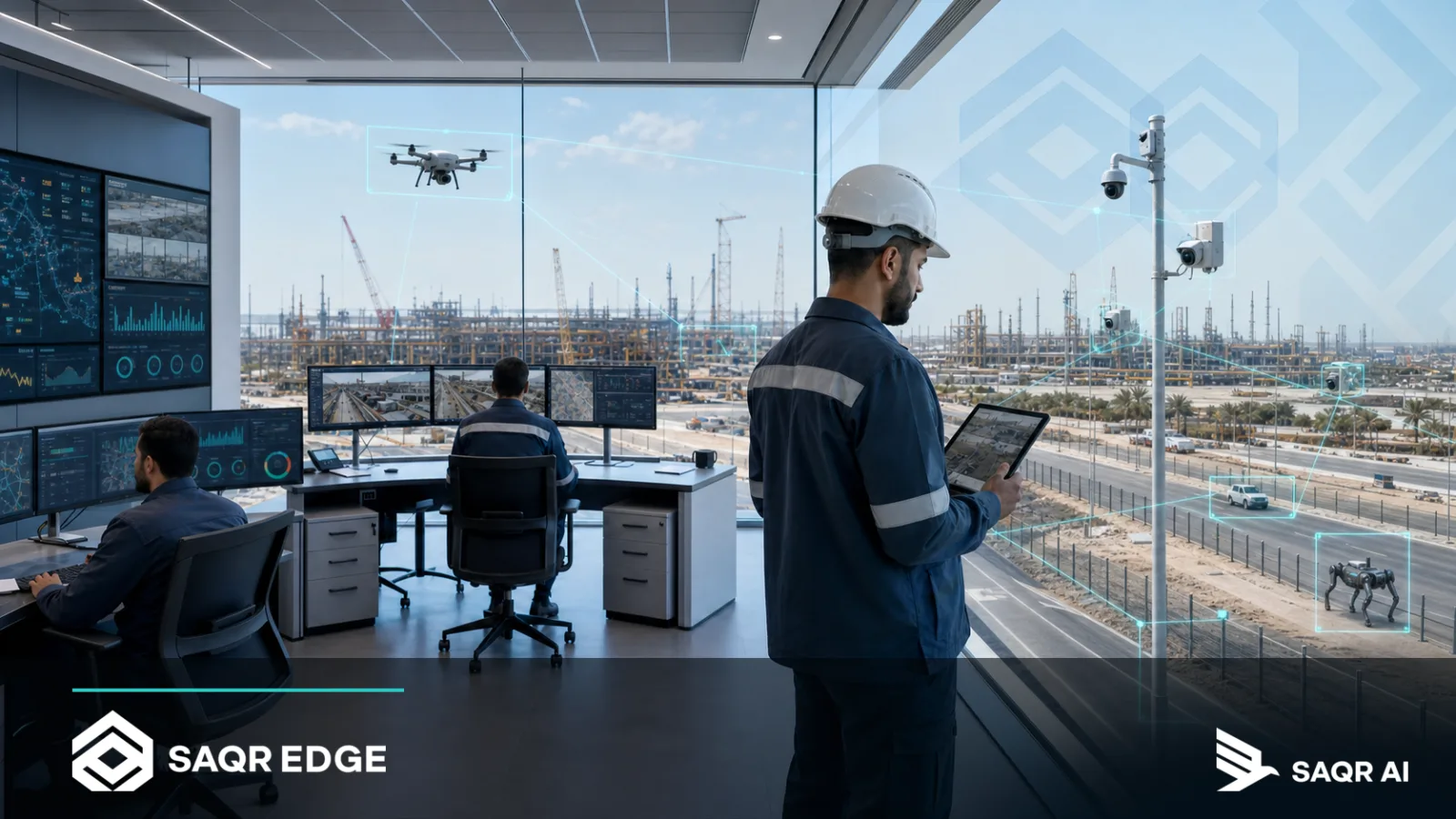
SAQR EDGE: End-to-End AI Event Management for Sites and Perimeters
On many industrial, infrastructure and agricultural sites, the problem is no longer the absence of cameras.
Cameras are already there. They monitor gates, perimeters, storage yards, production zones, equipment areas, temporary roads, remote facilities, agricultural land and critical infrastructure points. In some cases, there are even too many cameras.
But a site manager still may not understand the most important things: what is really happening on the site, where productivity is being lost, which events repeat, who must respond, how quickly the response happened and where the site remains vulnerable.
A camera by itself does not create manageability.
A camera creates an image. Manageability appears when visual information becomes an event, the event becomes a task, the task becomes a response, and the response becomes reporting and a management decision.
This is how we look at SAQR EDGE.
SAQR EDGE is not simply a set of cameras and not just another video analytics module. It is a full visual AI layer for sites where it is important to see, interpret, classify, respond and prove that control actually works.
In simple terms, anything that a person can visually observe on a site can potentially be transformed into a digital event.
But this does not happen automatically. The right visual source must be selected. The camera or mobile platform must be placed in the right point. The scenario must be configured. The quality must be tested in real conditions. The event must be linked to a responsible person and embedded into the operating process.
That is why SAQR EDGE is not only software.
It is a turnkey service: from site assessment to a working event, response and scaling contour.
Why Installing Cameras Is Not Enough
Traditional video surveillance is often built around the archive.
Something happened, and then people search the recording. Someone crossed the perimeter, and then the team checks when it happened. Smoke or fire appeared, and then the organization tries to understand who noticed it first. An unauthorized person entered a zone, and then the manager checks why the response took so long.
This approach is useful for investigation, but it is weak for real-time management.
On a real site, an event has value when it can still be influenced. If the system only recorded video but did not help the team understand what was happening, the value is limited. If an operator saw the event but it did not reach the responsible person, the management loop is broken. If the response happened but was not recorded in the platform, the manager cannot measure control quality. If events repeat but do not enter reporting, the site continues to live with the same risks.
So the main question is not how many cameras are installed.
The main question is whether the site has an event-management contour.
What We Mean by the Full SAQR EDGE Contour
For us, SAQR EDGE does not start with an algorithm or a presentation of AI capabilities.
It starts with the site.
We need to understand where the site boundaries are, which zones are critical, which events really matter, where cameras already exist, where visibility is missing, how security is organized, who makes decisions, which regulations exist and what reports management needs.
Only after that can the system be designed.
The full SAQR EDGE contour includes:
- site assessment and mapping of key observation zones;
- selection of scenarios for the first pilot;
- design of stationary camera placement and mobile observation tools;
- equipment selection for the site conditions;
- installation of cameras, masts, edge nodes and supporting infrastructure;
- connection of video streams;
- detector configuration;
- calibration of zones and event rules;
- an event-management platform;
- notifications to responsible teams;
- response logging;
- event and KPI reporting;
- recommendations for scaling.
This is important because a site cannot simply buy “AI” and expect it to integrate itself into operations.
AI must be embedded into the process.
That is the difference between a demonstration and an implementation.
How SAQR EDGE Collects Visual Data
A site does not have one universal way of seeing.
A perimeter is often best covered by stationary cameras. A remote area may be better inspected by a drone. A complex industrial zone may require a ground robot or a robot dog. Water assets, canals, shorelines and hydraulic infrastructure may require an unmanned surface vessel.
SAQR EDGE is built around the task, not around one device type.
Depending on the site, the contour can include:
- stationary cameras;
- temporary cameras and masts;
- drones for aerial inspection;
- ground robotic platforms, including robot dogs;
- unmanned surface vessels for water-related sites;
- edge nodes and local processing servers;
- an event-management and reporting platform.
Different visual sources create different management value.
A stationary camera provides permanent control over a defined zone. A drone provides a fast overview of a large territory and helps inspect areas that are difficult to reach. A ground robot can operate where it is inconvenient or unsafe for a person to remain constantly. An unmanned surface vessel can extend visual control to water infrastructure.
But these devices are not the product by themselves.
The product appears when the visual source is connected with AI analytics, an event platform, responsible people and a clear response logic.
Stationary Cameras as the Base of Managed Analytics
Stationary cameras remain one of the most practical elements of site-level AI.
They provide a fixed angle, a permanent observation zone and repeatable conditions for analysis. This is especially useful for:
- perimeters;
- entrances and exits;
- material storage areas;
- remote zones;
- agricultural sites;
- construction sites;
- hazardous areas;
- HSE control;
- access-controlled facilities;
- territories where it is important to detect human presence, smoke or fire quickly.
A fixed view makes it easier to configure zones, rules and response thresholds.
But even here it is important not to confuse camera installation with system deployment. The same camera can be useless if it is placed incorrectly. The same zone can generate many false events if light, dust, shadows, moving equipment, vegetation, weather conditions or perimeter specifics are not considered.
In SAQR EDGE, a camera is part of the operational architecture.
It should not only “look”. It should help detect a specific event, in a specific zone, with a clear response rule.
Which Processes Can Be Interpreted
In industrial AI, it is dangerous to promise too much before testing the technology on a real site.
Different sites create different conditions. Different cameras produce different video quality. Different scenarios require different accuracy and different response logic.
At the same time, the logic of SAQR EDGE is much wider than one fixed set of detectors.
If a production or site process can be visually observed, it can begin to be interpreted.
Not in the abstract sense that “AI understands everything by itself”. In the applied sense: the site is described, the scenario is formalized, the video stream is connected, the model is adapted, event rules are configured, quality is checked and the result is linked to response.
This logic can be applied to many types of visual processes:
- human presence in a controlled zone;
- movement of people, machinery or vehicles;
- perimeter crossing;
- entering or leaving a zone;
- smoke, fire and early signs of incidents;
- violation of a safe zone;
- presence near a hazardous area;
- loading and unloading;
- machinery movement along a route;
- activity on a work front;
- accumulation of people or vehicles;
- visual confirmation that an operation was completed;
- site condition before and after work;
- events on water surfaces or along shorelines.
These scenarios should not be packaged as an endless list of features.
They should be selected for the site and for the management task.
In the first pilot, the basic events may be simple: a person in a controlled zone, fire or smoke. But this is not the boundary of the product. It is the starting layer that allows the customer to test the architecture, video quality, processing stability, response rules and reporting.
The contour can then expand to the processes that are truly important for the customer.
The goal of the pilot is not to show the maximum number of scenarios. The goal is to prove that selected visual events can be detected reliably in the conditions of a specific site and transformed into a management process.
Why the Platform Matters More Than the Detector
A detector is only one layer.
It answers the question: “Did the system see something?”
But a customer needs a longer answer:
- where it happened;
- when it happened;
- how critical the event is;
- who received the notification;
- who confirmed the event;
- who responded;
- how long the response took;
- whether the event repeats;
- what must change on the site;
- whether the scenario can be scaled to other zones.
If these questions are absent, AI remains a technical function.
If these questions are embedded into the platform, AI becomes part of management.
That is why SAQR EDGE should be described as an AI event-management platform, not only as object recognition.
The point is not to add one more screen to the control room. The point is to give the site a managed stream of events.
Response Is the Main Layer of Value
On a site, value is created not only by detection, but by response.
If the system detected a person in a controlled zone but security did not receive the signal, there is no result. If the system saw smoke but the responsible person did not confirm the event, the risk remains. If an event was closed manually but was not recorded in the platform, the manager does not see process quality. If the same area constantly produces violations but they do not become a KPI, the problem repeats.
SAQR EDGE must cover not only the layer of “seeing” but also the layer of “acting”.
In practice, this means:
- events must have priority;
- notifications must go to responsible teams;
- response must be recorded;
- statuses must be clear;
- repeated events must enter analytics;
- management must see not only a video frame but the operational picture.
This is especially important for sites where control is distributed across several teams: security, operations, HSE, contractors, dispatchers and site managers.
If every team lives in its own communication channel, events are lost. The platform is needed to connect observation, responsibility and result.
Where SAQR EDGE Is Most Applicable
SAQR EDGE is most useful where a site is large, distributed or sensitive to response delays.
It can be applied to:
- infrastructure assets;
- industrial sites;
- energy facilities;
- water and utility infrastructure;
- agricultural territories;
- remote bases and warehouses;
- construction sites;
- perimeter-security sites;
- access-controlled zones;
- locations where HSE events matter.
Central Asia and MENA are especially important use cases.
These regions have large territories, remote assets, infrastructure construction, agricultural holdings, energy sites and facilities with high requirements for security and perimeter control.
For such conditions, it is not enough to think only in the logic of “a camera sends video to the center”. The architecture must work closer to the site, process events locally and send structured information outward.
Why Edge AI Matters for Remote Sites
On remote sites, connectivity may be unstable. Constantly transmitting the full video stream may be expensive or technically inconvenient. In addition, there is not always a reason to send hours of raw video outside the site.
It is more useful to transmit what already has management meaning:
- an event;
- an event frame;
- a short clip;
- time and location;
- event type;
- response status;
- a reporting metric.
This helps the site avoid overloading communication channels and receive more useful information.
Edge AI does not replace the central platform. It makes the platform more practical.
Part of the analytics happens closer to the source, while the platform receives a structured stream of events. For perimeter security, agriculture, energy, infrastructure and remote locations, this can be critical.
What “Turnkey” Means in SAQR EDGE
For the customer, “turnkey” does not mean installing equipment and handing over a login to the platform.
In site-level video analytics, this almost never works.
Turnkey means that we take responsibility for the full path from idea to a verified operational contour.
First, we analyze the site: where critical zones are located, which processes must be observed, where existing cameras are already installed, where new viewpoints are needed, where a drone, ground robot or unmanned surface vessel may be relevant, which events have management meaning, who must receive notifications, how the response should look and which reports management needs.
Then the technical configuration is designed. It may include cameras, masts, edge computing, mobile platforms, connectivity, the event platform and response rules.
After that come installation, connection, configuration, quality testing, user training and pilot operation.
At the end, the customer should receive not only a working screen. The customer should receive a clear system:
- which events are monitored;
- which zones are covered;
- who is responsible for response;
- how the result is recorded;
- which indicators enter reporting;
- what must be changed on the site;
- which scenarios can be scaled next.
This is what separates SAQR EDGE from a standard camera supply or a standalone AI module.
We do not simply add technology to the site. We help embed visual AI into the site’s operating model.
Local Teams and Workforce Sovereignty
SAQR EDGE is connected not only with technology but also with the topic of workforce sovereignty.
Even the best system will not work sustainably if the customer does not have people who understand how to use it.
Operators must know how to read events. Responsible teams must understand response rules. Managers must look not only at video but also at KPIs. Technical specialists must understand when the angle, scenario, settings or regulation needs to be changed. Teams must be able to distinguish a technical issue from an organizational one.
That is why a SAQR EDGE pilot should end not only with an event report.
It should leave the customer with an understanding of:
- which scenarios work;
- which conditions are needed for quality;
- which roles must be assigned;
- which regulations must change;
- which data must be reviewed daily;
- how to scale the system to other zones.
This is how technology becomes not an external “box” but part of local site competence.
What a SAQR EDGE Pilot Should Prove
A good pilot should not be too wide.
If too many scenarios, zones, cameras and expectations are included at once, the pilot becomes noise. It is better to choose one site, several zones and a limited set of events.
At the end, the pilot should give the customer practical answers:
- where the system helps see events earlier;
- which events are confirmed reliably;
- where false events appear;
- which site conditions affect quality;
- which cameras must be moved or added;
- which roles and regulations are needed for response;
- which KPIs can be used;
- how long the response takes;
- which scenarios should be scaled first.
This is a mature approach to applied AI implementation.
Not “look how beautifully the model works”, but “these are the events we see, this is how the team responds and this is what is needed for scaling”.
The Main Idea
SAQR EDGE is not a story about cameras.
It is a story about site manageability through visual data.
A camera, drone, robot or unmanned surface vessel sees. Edge AI classifies. The platform records the event. The team responds. Reporting shows the result. The manager makes a decision.
Value appears in this chain.
For infrastructure, industry, agriculture, perimeter security, water assets and remote sites, this logic becomes especially important. In the real world, it is not enough to know that an event happened. A system must be built in which the event is not lost.
SAQR EDGE helps customers move from video surveillance and scattered visual sources to event management.
From image to interpretation. From interpretation to response. From response to KPI. From KPI to a scalable operating model.
Read more:
- SAQR EDGE: From Cameras to Events and Response
- Applied AI for MENA Implementation
- Workforce Sovereignty as Part of Technology Sovereignty
SAQR AI website: http://saqr-ai.com/
SAQR EDGE website: https://saqredge.com/