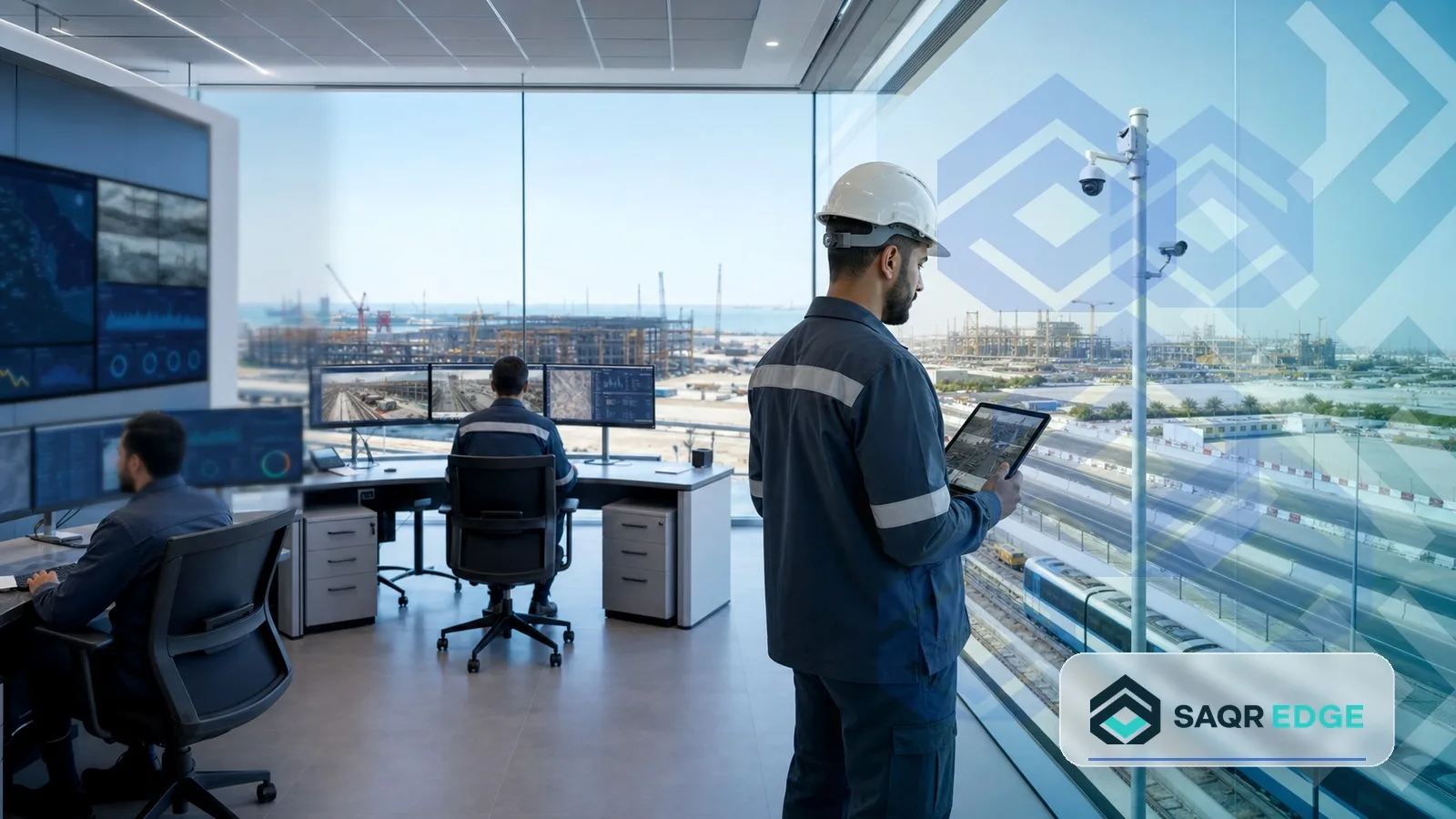
SAQR EDGE: From Cameras to Events and Response
Many sites already have cameras.
They are installed on the perimeter, at entrances, storage zones, construction areas, industrial yards, temporary roads and high-risk locations.
Sometimes there are dozens of cameras. Sometimes hundreds.
But having cameras does not automatically mean that the site is managed better.
A camera shows an image. Video monitoring helps people see what is happening. An archive helps investigate after an event.
But for operational management, this is not enough.
A site manager does not simply need a video stream. They need to understand what happened, how critical it is, who must respond, how quickly the response was completed and how it appears in reporting.
This is why SAQR EDGE is not built as “another video surveillance system”. It is built as an operational service for infrastructure and industrial sites.
Its purpose is to help move from cameras to events, from events to response, and from response to KPIs and manageability.
Why video monitoring is not site management
Video monitoring answers the question: “What is visible in the frame?”.
Site management answers a different question: “What should happen after it becomes visible?”.
The operational value lives between these two questions.
If a system only shows an image, a person has to keep watching screens, notice deviations, understand event criticality, remember the procedure, contact the responsible people and then record the result.
On a real site, this approach quickly reaches the limits of attention.
An operator can miss an event.
A responsible person can receive a signal too late.
A manager can see the problem only in a report after the shift.
Repeated violations can remain visual noise because they are not turned into a measurable management signal.
SAQR EDGE works with a different logic.
A camera is not the end point of the system. A camera is a source of observation.
Value appears when observation becomes an event, the event becomes a task, the task becomes a response, the response becomes reporting, and reporting becomes a management decision.
What SAQR EDGE is
SAQR EDGE is the SAQR AI direction for industrial computer vision, edge AI and site analytics.
In practical terms, it is not only software and not only a recognition algorithm.
SAQR EDGE is treated as an end-to-end service for the site:
- site survey and observation-zone assessment;
- design of the camera and analytics loop;
- selection and installation of stationary cameras;
- deployment of edge computing on site;
- connection of video streams;
- calibration of detectors and event rules;
- event monitoring;
- notifications and response;
- reporting and KPIs;
- integration into the customer's processes.
This structure matters because on a real site it is rarely enough to simply “install AI”.
The team has to understand where a camera should be placed, which viewing angle is required, which zones are critical, which events truly matter, who receives the signal, what counts as a false positive, how response is recorded and which metrics prove impact.
Without this loop, computer vision remains a demonstration.
With this loop, computer vision becomes part of operational management.
Stationary cameras as the basis for stable analytics
For many infrastructure and industrial sites, stationary cameras remain the basic element of the system.
They provide constant visibility, a fixed angle and a clear zone of responsibility.
This is especially important for:
- site perimeter;
- entrances and exits;
- material storage zones;
- construction areas;
- hazardous zones;
- temporary roads;
- work fronts;
- HSE-risk areas;
- zones where regular event confirmation is required.
A stationary camera is valuable not only because it “sees”.
It is valuable because it allows repeatable analytics to be built.
When the angle is stable, zones, rules, thresholds, scenarios and response procedures can be calibrated more precisely.
This reduces chaos in the data and makes events more manageable.
For SAQR EDGE, a stationary camera is not a separate device. It is part of the site's operational architecture.
It is not enough to install a camera. It is important to understand which management event the camera should help capture.
Edge AI: why processing should be closer to the site
On infrastructure sites, it is not always possible to rely on constant transmission of large video streams to the cloud.
Connectivity can be unstable.
The channel can be expensive.
The site can be remote.
Video can contain sensitive information.
This is why the principle of edge AI is important for SAQR EDGE: video processing should be performed closer to the source, on site.
In this architecture, it is not necessary to send every hour of raw video outside the site. More valuable elements can be transmitted instead:
- events;
- notifications;
- counters;
- event frames;
- short clips;
- geotagged incidents;
- response logs;
- reporting indicators.
This changes the meaning of the system.
Instead of overloading the network with video streams, the site receives structured events that can be managed.
This is how video analytics becomes not just analysis of video, but part of the operational loop.
From detector to event
A detector by itself is not the result.
A detector can identify a person in a zone, smoke, fire or another event.
But for the customer, the most important point is not only that the system recognized something.
The important point is what happens next.
An event should have:
- type;
- time;
- location;
- zone;
- priority;
- confirming frame or clip;
- responsible person;
- response rule;
- status;
- outcome.
If these elements are missing, the event remains just a mark in the system.
If these elements are present, the event becomes part of management.
This is why SAQR EDGE should not be described as “AI recognizes objects”. It should be described as a system that helps manage site events.
This is especially important during a pilot: it is better to confirm several key events in real conditions than to promise a wide list of detections that have not yet been verified on the specific site.
Response is the key value layer
On a site, value is created not only by detection.
Value is created by response.
If the system sees an event but no one responds, there is no management result.
If the event reaches the responsible person but no action is recorded, manageability cannot be proven.
If the event repeats every day but does not enter KPIs, it remains an operational habit rather than a management problem.
That is why SAQR EDGE should work not only as an analytics layer, but also as a response layer.
In practice, this means:
- notifications to responsible people;
- event prioritization;
- status tracking;
- connection to SOP;
- action logs;
- event reports;
- analysis of repeated violations;
- response-time metrics;
- false-positive metrics;
- conclusions for the site manager.
This is how the camera stops being just an eye.
It becomes part of a system that helps the site respond faster and prove that control is actually working.
Why SAQR EDGE is an end-to-end service
It is a mistake to think that industrial computer vision can be implemented only by installing software.
In reality, site analytics depends on many factors:
- where the camera is placed;
- what enters the frame;
- which zones are critical;
- what lighting conditions exist day and night;
- whether there is dust, smoke, fog, glare or vibration;
- how connectivity is organized;
- who monitors the events;
- who is responsible for response;
- which procedures already exist;
- which reports the manager needs;
- which KPIs matter to the customer.
That is why SAQR EDGE should be implemented as a service, not as a “program that is simply switched on”.
This format includes survey, design, equipment, installation, configuration, analytics and support for the operational loop.
This is especially important for MENA, KSA, UAE and Central Asia, where sites can be large, distributed, climate-sensitive and in need of local adaptation.
On one site, the main scenario may be perimeter control.
On another, HSE events.
On a third, smoke or fire detection.
On a fourth, work-zone control and response.
A universal presentation does not solve these differences.
The solution has to be configured for the site.
What a SAQR EDGE pilot should prove
A pilot should not prove that AI “can see in general”.
That is no longer the main question.
A pilot should prove that SAQR EDGE can work in the customer's specific environment.
For this, the pilot should be focused.
One site.
One or two key tasks.
A limited number of cameras.
Clear zones.
Clear events.
Clear quality criteria.
A clear reporting format.
The practical result of the pilot should include more than attractive screenshots. It should include evidence of applicability:
- which events were captured;
- how many confirmed events were recorded;
- how many false positives occurred;
- how quickly the responsible team responded;
- which zones were problematic;
- which cameras or angles need adjustment;
- which conditions are required for scaling;
- which scenarios should remain in the first loop and which should move to the roadmap.
Such a pilot helps the customer make a decision.
Not at the level of “interesting technology”.
But at the level of “this can be implemented, adapted and scaled”.
What should not be promised too early
In industrial AI, it is dangerous to promise too broad a list of functions before verification on site.
Every site is different.
Every camera is different.
Every scenario requires verification.
That is why a mature SAQR EDGE position should be honest: we can show a working architecture, select key scenarios, adapt models to the site, confirm quality and then expand the loop.
This approach is stronger than the promise that “we recognize everything”.
For the customer, the width of the presentation matters less than the reliability of the first operational result.
If the pilot confirms key events, tests response rules, measures false positives and defines scaling conditions, it becomes a basis for the next stage.
This is how trust in applied AI is built.
Where SAQR EDGE is most useful
SAQR EDGE is most useful where an event must be noticed quickly, classified correctly and brought to response.
This may include:
- infrastructure construction;
- transport assets;
- industrial sites;
- energy infrastructure;
- water and utility infrastructure;
- remote sites;
- construction zones in urban environments;
- sites with increased HSE requirements;
- sites where manual control is overloaded.
In all of these cases, the camera itself does not solve the problem.
The problem is solved by the loop: camera, edge AI, event, responsible person, response, reporting and KPI.
This is the loop that SAQR EDGE makes the subject of implementation.
How SAQR EDGE connects to the SAQR AI ecosystem
SAQR EDGE is one of the key products in the industrial vertical of SAQR AI.
It is responsible for the layer of observation, video analytics, events and response.
But in real implementation, it is connected with other layers of the ecosystem.
If an event is related to equipment, it can connect to the production-cycle logic of BIS-ON.
If the site needs to train operators, dispatchers and managers to work with AI events, the methodology of SAQR ACADEMY becomes involved.
If the customer wants to move from pilot to scaling, the broader SAQR AI methodology is required: task, pilot, metrics, adaptation and scale.
This is how SAQR EDGE stops being a separate software product.
It becomes part of the operational architecture.
The main principle
SAQR EDGE is built around a simple idea:
A camera should not only watch.
It should help manage an event.
A site does not need one more screen.
A site needs a clear loop: see, classify, transmit, respond, record, measure and improve.
This is why SAQR EDGE is not video surveillance for the sake of video surveillance.
It is a step from observation to manageability.
From camera to event.
From event to response.
From response to provable operational result.
SAQR AI website: http://saqr-ai.com/
SAQR EDGE website: https://saqredge.com/