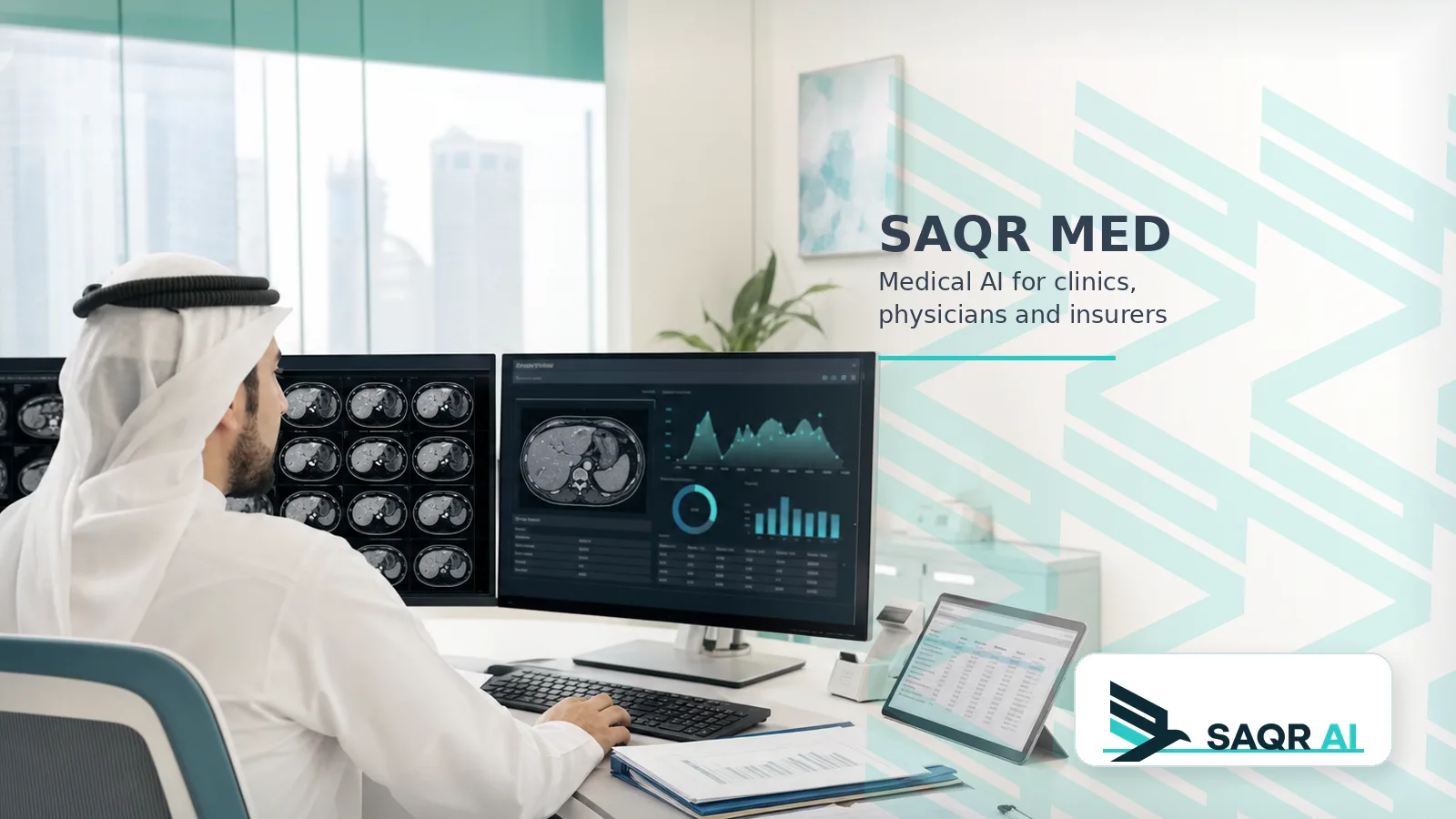
SAQR MED: Medical AI for Clinics, Physicians and Insurance Companies
When medical AI is discussed too loudly, the conversation can quickly become dangerous. It may sound as if an algorithm should replace the physician, make the diagnosis on its own and take decisions on behalf of a clinic or an insurance company. Real healthcare does not work that way. Clinical responsibility remains with the physician, while technology should help where people need speed, attention, consistency and an additional layer of review.
This is the lens through which we look at SAQR MED. For us, medical AI is not a showcase demo and not a remote cloud service where a clinic has to continuously send patient data outside its perimeter. It is an applied tool that can operate inside a healthcare organization, support the clinical team in MRI and CT image analysis and create a clearer workflow for physicians, clinics and insurance companies.
The core idea is simple: SAQR MED does not replace the physician. It is designed to strengthen the medical process.
Why the value of medical AI is wider than model accuracy
Model accuracy is important, but it is not enough for the market. A clinic does not only ask whether the algorithm works well. It also needs to understand how the system will fit into the workflow, where the data will be stored, how the physician will see the result, who remains responsible for interpretation and what the clinic retains after implementation.
A physician looks at the problem differently. The real value is not another software layer. The value is less routine pressure, faster attention to suspicious areas, easier comparison of medical images and full control over the clinical decision.
An insurance company has a third perspective. It needs to understand whether a medical case is properly supported, whether the documented diagnosis is consistent with the image evidence, whether there is an additional analytical layer for expert review and whether the number of disputed cases can be reduced. But here too, AI should not become an automatic judge. It can only be an additional analytical tool that helps experts work with medical information more consistently.
That is why SAQR MED should not be viewed as “AI for an image”. It should be viewed as part of a clinical and expert workflow.
What SAQR MED is
SAQR MED is the medical vertical of SAQR AI, focused on computer vision for MRI and CT analysis. The first product release is focused on the liver model and focal liver pathologies, including use cases where early visual identification and follow-up monitoring have high practical value.
We describe the product roadmap carefully: liver is the first release; heart, pancreas and kidneys are next directions in the product logic and development pipeline. It is important to separate what is ready to discuss today from what should be communicated as a roadmap.
The key formula of SAQR MED is:
A trained model. Transferred to the customer. Running locally.
This is a fundamental difference from a typical SaaS logic. We are not building the message around the idea that medical data should constantly move into an external vendor cloud. The SAQR MED approach assumes local operation of the model inside the clinic perimeter, transfer of usage rights, training of the team and integration of the result into the actual clinical process.
Why we start with the liver
The liver is one of the organs where early identification of focal pathologies is especially important. According to the GLOBOCAN / IARC 2022 factsheet, liver and intrahepatic bile duct cancer ranked 7th globally by the number of new cases, with approximately 843,045 new cases, and 3rd by mortality, with approximately 732,489 deaths: https://gco.iarc.who.int/media/globocan/factsheets/cancers/11-liver-and-intrahepatic-bile-ducts-fact-sheet.pdf
Another important risk factor is chronic hepatitis B. According to the World Health Organization, in 2024 around 240 million people were living with chronic HBV infection, while hepatitis B mortality is mostly related to cirrhosis and hepatocellular carcinoma: https://www.who.int/news-room/fact-sheets/detail/hepatitis-b
For MENA, Central Asia, Africa and other fast-developing healthcare markets, this is not abstract statistics. It is a question of healthcare system capacity, diagnostic quality, access to expertise and the ability of clinics to work with medical images in a more systematic way.
This is why the liver model is a logical first entry point for SAQR MED. It allows us to speak not only about technology, but about a specific medical task.
Value for clinics
For a clinic, SAQR MED can be useful as an additional layer of control and organization for MRI and CT work. As diagnostic departments face increasing workload, value is created not only by image analysis itself, but also by making the process more consistent, structured and convenient for the team.
The clinic can build a local medical AI environment without turning patient data into a permanent external data flow. This is especially important for healthcare organizations that operate under regional data-protection frameworks and need to take into account requirements for storage, access and medical responsibility.
The practical effect for a clinic can appear in several areas:
- faster initial work with large volumes of medical images;
- an additional layer of attention to suspicious areas;
- support for quality and consistency of analysis;
- a clearer basis for internal review and expert discussion;
- development of AI competence inside the clinic itself.
SAQR MED is not designed to make the clinic dependent on an external black box. The product logic is built around model transfer, local operation and team training.
Value for physicians
For physicians, the value of medical AI must be very concrete. If the system creates extra screens, distracts the team and takes more time, it does not help. If it carefully highlights meaningful areas, helps the physician navigate images faster, preserves the structure of work and leaves the final decision to the physician, then it becomes a useful tool.
SAQR MED is designed to work in this logic. The model can help draw attention to visual signs, support the analysis of focal changes, simplify comparison and reduce the risk of missing an important element under high workload.
The final medical interpretation remains with the physician. This is not a legal disclaimer for appearances. It is a principle of trust. The physician understands the clinical context, patient history, related factors and limitations of each diagnostic method. AI should be a second layer, not a replacement for professional judgment.
This position also matters for adoption. The physician should see SAQR MED not as a competitor, but as a tool that helps work faster, more attentively and with greater confidence.
Value for insurance companies
For insurance companies, medical AI opens a separate use case. In health insurance, it is important not only that a document exists, but also how well the case is supported: whether the medical event is confirmed, whether the described diagnosis is consistent with the visual picture and whether there is a basis for additional expert review.
SAQR MED can be useful as an additional analytical layer for insurance case review. It can help with case confirmation, review of diagnostic consistency and reduction of disputed situations between participants in the process.
The boundary is important. AI should not automatically approve or reject an insurance case. Such a decision must remain within medical and insurance expertise. But AI can help experts work with images and documented medical evidence faster and more consistently.
For an insurance company, this is not only about cost control. It is about trust, transparency and higher-quality expert review of complex cases.
Why local deployment matters for MENA and Central Asia
MENA and Central Asia are rapidly developing healthcare infrastructure. Clinics are being built, equipment is being renewed, demand for diagnostic quality is growing and data governance is becoming more important. In this environment, medical AI should not simply be an imported service. It should be a practical tool that can be integrated into the local clinical process.
Local model operation gives the clinic more control. Data stays inside the healthcare organization, the team gains the skill to work with AI, and implementation can be adapted to real processes, language, regulations and the readiness level of the medical organization.
For SAQR MED, this is a principled framework. We do not want to sell abstract “AI from the cloud”. We want to transfer to the customer a tool that can work next to the physician, inside the clinic and within a clear system of responsibility.
What a proper SAQR MED pilot can look like
A medical AI pilot should not start with the promise that “we recognize everything”. It should start with a question: which clinical task do we want to improve and how will we measure the value for the physician, the clinic and, where relevant, insurance expertise?
A proper pilot framework can include several steps:
- Define the specific image type and clinical scenario.
- Agree on the physician’s role and the rules for interpreting AI results.
- Test the model on relevant data.
- Evaluate how the result fits into the clinic’s workflow.
- Train the team to work with the tool.
- Capture practical value: speed, usability, consistency and quality of expert review.
This approach is more honest than a demonstration for the sake of a demonstration. It shows where AI truly helps and where further adaptation, calibration and clinical validation are required.
What SAQR MED does not promise
In medical AI, it is especially important to speak calmly. SAQR MED does not replace the physician, does not make a diagnosis instead of the clinical team and should not be used as the sole basis for a medical or insurance decision.
We also do not present all future directions as ready products. The liver model is the first release. Heart, pancreas and kidneys are development directions that should be disclosed as readiness is confirmed.
This level of caution does not weaken the product. On the contrary, it makes it more mature. The healthcare market does not need loud promises. It needs responsible technology that is understandable to physicians and suitable for real clinical work.
The main idea
SAQR MED is medical AI that should work not instead of the physician, but alongside the physician. For clinics, it can provide a local MRI and CT analysis environment. For physicians, it can provide an additional layer of attention and speed. For insurance companies, it can provide a tool for more consistent expert review of cases.
For us, medical AI does not start with the claim that a machine will replace a person. It starts with respect for clinical responsibility, patient data and the real work of the medical team.
This is why the SAQR MED approach is clear:
A trained model. Transferred to the customer. Running locally.
Learn more about the SAQR AI ecosystem: https://saqr-ai.com/
SAQR MED: https://saqr-med.com/