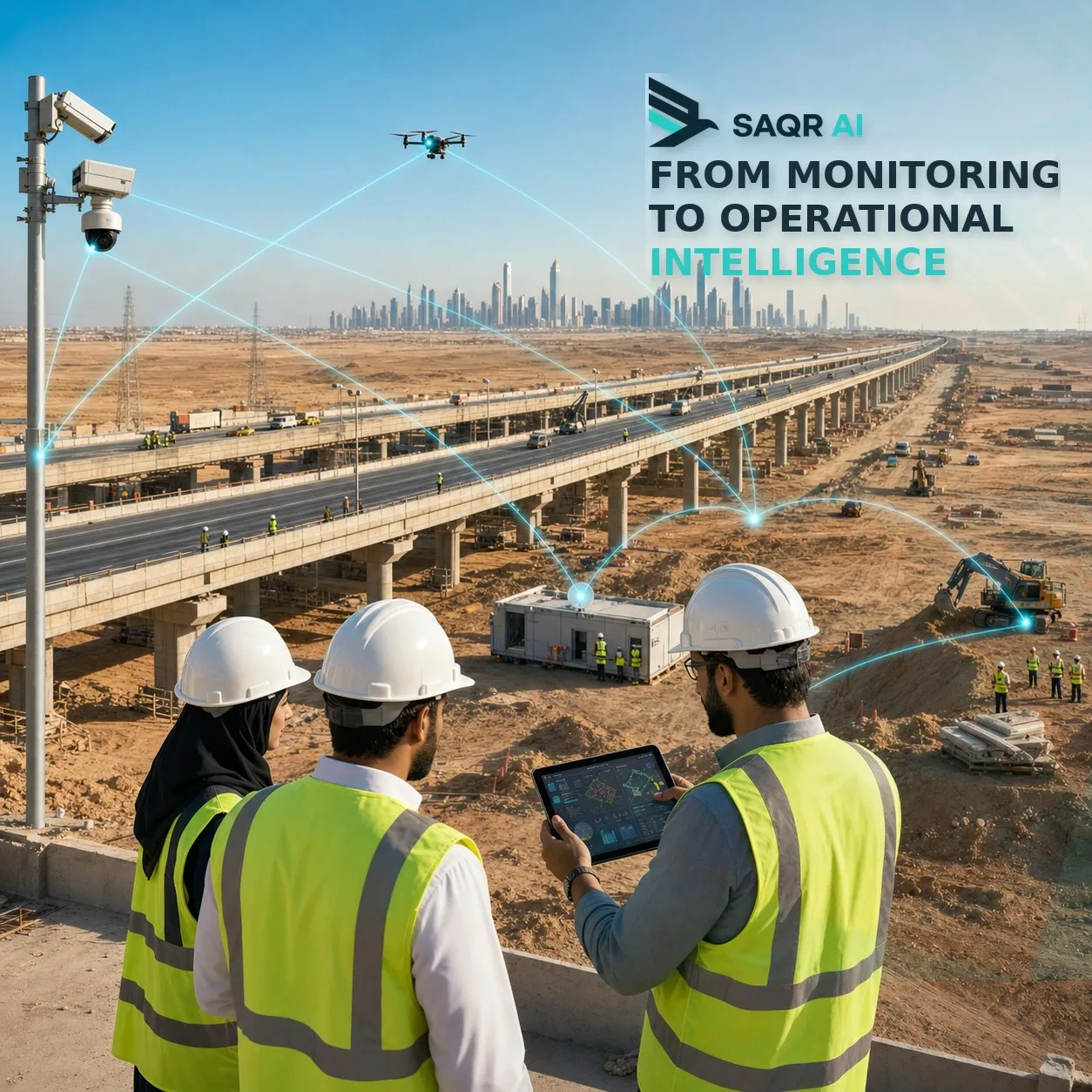
SAQR AI: From Monitoring to Operational Intelligence
Infrastructure projects today do not suffer from a lack of data.
Sites already have cameras, drones, sensors, reports, schedules, BIM models, spreadsheets, dashboards and daily meetings. A project leader can access more information than ever before.
But the main question remains the same:
Does this information help manage the site right now?
If a system only shows a picture, it does not change the process. If a dashboard only records a deviation after the fact, it does not prevent losses. If a camera only records video, it does not create a management action.
That is why infrastructure, industry and large construction programs need the next step: a transition from monitoring to operational intelligence.
Monitoring Shows. Management Changes the Situation
Monitoring answers the question: what is happening?
This is an important first level. Without observation, it is impossible to understand the state of a site, see risks, record deviations and collect evidence.
But this is not enough for operational management.
Management asks different questions:
- which observations really matter;
- who must respond;
- how quickly action is needed;
- what was done;
- what result was achieved;
- whether the problem is repeated;
- how it affects schedule, cost, safety and productivity.
This is where the difference appears between digital visibility and operational intelligence.
Digital visibility creates more screens.
Operational intelligence supports decisions.
Why “One More Dashboard” Does Not Solve the Problem
In many projects, digital transformation starts with the right idea: collect data, show it on a screen and give leadership more transparency.
But then a typical problem appears.
There is more information, but not more manageability.
The team sees charts, but does not always understand which events require action. Cameras show the site, but responsibility for what is seen remains unclear. Reports record deviations, but often after time has already been lost.
This creates an illusion of control.
It may seem that the site is being managed because it is visible on a screen. But real management begins only when observation becomes action.
Operational Intelligence: Connect Event, Responsibility and Response
For SAQR AI, the key logic is simple:
**observation must become an event;
the event must have an owner;
the owner must respond;
the response must be measured.**
If this chain is not built, AI remains a demonstration.
If it is built, technology becomes part of the operational process.
For example, a video stream by itself is not a management tool. But if a system detects an event, classifies it, sends it to the responsible person, records response time and shows whether the problem is repeated, then the video stream becomes a source of management.
The same logic applies to equipment, shift tasks, downtime, productivity, safety, medical data and personnel training.
Value is not created by the mere fact that data exists.
Value is created by the management loop around the data.
Why This Matters for MENA and Central Asia
MENA and Central Asia are implementing major infrastructure, industrial, energy, transport and urban development programs.
In such projects, the cost of weak manageability is high.
Site complexity is growing. The number of contractors is increasing. Timelines are becoming tighter. Requirements for safety, transparency and efficiency are rising. At the same time, many sites are located in remote or rapidly developing areas, where local competence and clear operational processes are especially important.
That is why applied AI for these markets should not be an external showcase or a presentation layer.
It should help sites operate more precisely:
- see meaningful events;
- reduce information noise;
- support response;
- connect data with responsibility;
- measure results;
- leave competence inside the organization.
How This Connects to the SAQR AI Ecosystem
SAQR AI is not built around one function or one product.
We are building an applied AI ecosystem where different products cover different levels of operational management.
SAQR AI is the engineering core and master brand.
It brings together methodology, product architecture and an applied approach to implementing AI in real processes.
SAQR EDGE is industrial computer vision and edge AI for infrastructure and industrial sites.
Its task is to help a site move from video monitoring to events, analytics, alerts, response and reporting.
BIS-ON is focused on the operational efficiency of heavy equipment.
It does not work in the logic of “where is the machine?” It works in the logic of the production cycle: shift task, plan versus fact, downtime, productivity, equipment utilization and management discipline.
SAQR ACADEMY is the methodology and competence transfer layer.
Technology does not change a site by itself. It must be understood by managers, engineers, operators, educators and teams who will work with it every day.
SAQR MED is the medical vertical of the ecosystem.
It develops a medical computer vision approach for MRI and CT analysis, with the principle of local model operation inside the clinic and data control remaining with the medical organization.
These areas are different in their subject matter.
But the common idea is the same: AI must be embedded in the real process, not exist separately from it.
What a Good AI Pilot Should Prove
An AI pilot should not only prove that a model “recognized something.”
That is too weak a criterion.
A good pilot should show:
- which operational problem is being solved;
- which events are considered meaningful;
- who responds to these events;
- how response speed changes;
- which losses or risks become visible;
- which KPIs can be measured;
- what must change in the process before scaling.
If after a pilot there is only a beautiful demonstration, this is not implementation.
If after a pilot the team has a new management loop, clear metrics and practical methodology, this is already the beginning of transformation.
From Technology to Manageability
SAQR AI starts from a simple position: technologies are important, but by themselves they do not create results.
Results are created by the combination of:
data + model + process + responsibility + people + measured impact.
That is why we speak not only about artificial intelligence, but also about operational intelligence.
Because in a real infrastructure project, it is not enough to see more.
It is important to manage better.
Ecosystem website: saqr-ai.com