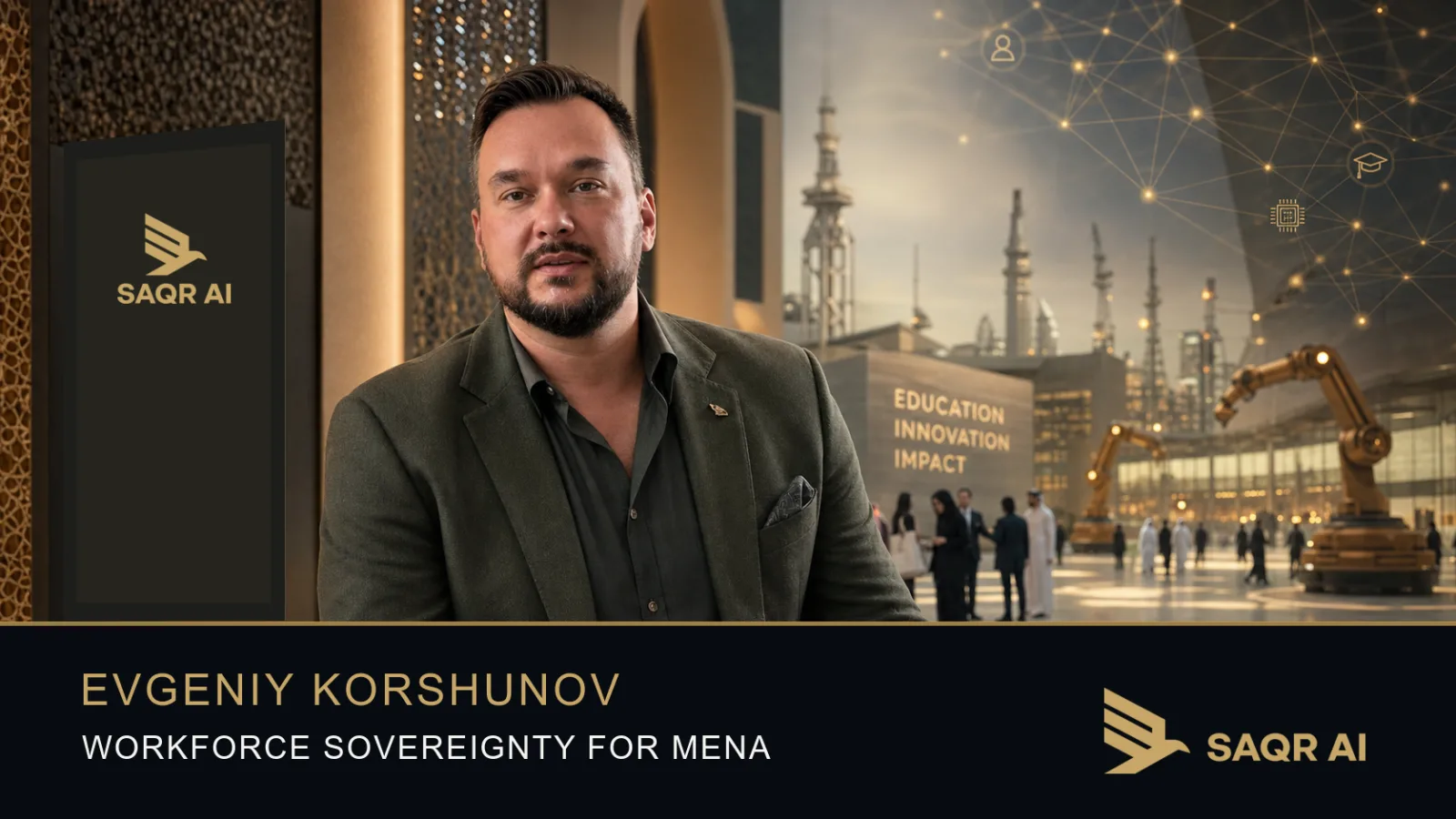
Beyond MBA: Why Workforce Sovereignty Matters for MENA
MBA remains one of the most recognized formats of business education in the world. It gives executives a common management language, a way to think about finance, strategy, marketing, operations and corporate governance.
But for the countries of the Gulf and the wider MENA region, the strategic task is broader than producing more people with prestigious diplomas.
The real task is workforce sovereignty.
By workforce sovereignty, I mean the ability of a country to prepare people for its own industries, its own national projects, its own management culture and its own long-term goals. It is not isolation from the world. It is the ability to absorb the best knowledge from the world and transform it into a national system of capability.
In this context, MBA is not the final answer. It is one important piece of a much larger puzzle.
MBA was created for a different historical task
MBA emerged in the early 20th century as a response to the rise of large industrial corporations. Harvard Business School was founded in 1908 to educate general managers for large-scale organizations that emerged after the Industrial Revolution: https://www.hbs.edu/about
That context matters.
MBA was built for a world where large companies needed professional managers: people who could understand business as a system, including finance, markets, organizational structure, strategy and operating models.
For that purpose, MBA is still useful.
But Gulf and MENA countries are now solving a different problem. They do not only need managers for existing companies. They need people who can build new sectors, manage megaprojects, develop local teams, transfer knowledge from external experts to national talent and turn Vision documents into execution.
That is no longer only an MBA task.
A diploma is not the same as capability
A diploma matters. It gives status, language, network and career legitimacy.
But a diploma does not automatically create capability.
Capability is the ability of a person, a team, a company or a country to perform a complex task in real life. Not to discuss a case, but to build an asset. Not to write a strategy, but to deliver a result. Not to complete a leadership module, but to organize a team, a shift, a construction site, a contractor or a national industry program.
If a country produces more diplomas but continues to depend on external expertise in strategic sectors, workforce sovereignty has not been achieved.
If universities graduate students but industry must still retrain them from the beginning, the system is not closed.
If executive education teaches attractive frameworks but does not help leaders manage real projects, education does not become national capability.
Why the China example is relevant
China is not relevant because it should be copied. It cannot and should not be copied.
China is relevant because it shows a principle: a country can absorb technologies, management methods and engineering knowledge from different parts of the world, but then adapt them to its own economy, governance culture, industrial policy and education system.
The key point is the connection between government, business and educational institutions.
In 2023, China issued guidelines on integrating industry and education in vocational education. The document emphasized the need to better align industrial needs with talent development, cultivate more than 10,000 enterprises focused on industry-education integration and build around 50 national pilot cities by 2025: http://english.www.gov.cn/news/202306/13/content_WS6488144dc6d0868f4e8dccce.html
The principle is clear. Education should not live separately from the economy. Industry should not simply complain that graduates are not ready. Government should not stop at strategy documents.
These three systems have to work as one mechanism.
For MENA, this is especially important.
What MENA can take from this logic
This is not about repeating the Chinese model. Gulf and MENA countries have their own culture, institutions, goals and speed of transformation.
But the principle is useful:
knowledge can be imported, but workforce sovereignty appears only when a country turns that knowledge into its own system for preparing people.
Saudi Arabia’s Vision 2030 is built around the themes of a thriving economy, employment opportunities, private sector partnerships and the development of talents and capacity: https://www.vision2030.gov.sa/media/rc0b5oy1/saudi_vision203.pdf
UAE Centennial 2071 connects the future of the country with excellent education, a diversified knowledge economy, innovation, entrepreneurship and higher productivity of the national economy: https://u.ae/en/about-the-uae/strategies-initiatives-and-awards/strategies-plans-and-visions/innovation-and-future-shaping/uae-centennial-2071
This is not only an education agenda. It is a national execution agenda.
If a country is building infrastructure, artificial intelligence, healthcare, logistics, energy transition, tourism, industry and new cities, it does not need only MBA graduates.
It needs people who know how to execute.
What should stand next to MBA
MBA can remain an important element. But it should stand next to a different educational architecture.
Industry-specific training. People cannot be trained in the same way for banking, hospitals, construction, logistics, AI and industry. Every sector has its own operational reality.
A direct link with industry. Universities should work not only with curricula, but also with real companies, sites, data, tasks and role requirements.
Practice beyond the classroom. Countries need simulators, internships, project assignments, analysis of real processes, work on sites and applied cases.
Preparation of the middle layer. Between strategy and the frontline, countries need people who can turn goals into an operating system: project managers, site managers, operations leads, supervisors, analysts and digital transformation managers.
Transfer of expertise. If external consultants and foreign specialists work in the country, there must be a mechanism for transferring knowledge to local teams. Otherwise, the capability remains outside.
Measurement of capability. The result of an education program is not attendance and not a certificate. The result is what a person can do after the program.
Why specialist education may be stronger than a fashionable diploma
It is important to bring respect back to specialist education.
In some countries, the word “specialist” may sound less prestigious than MBA. But for national development, a strong specialist track can be more important than another universal management diploma.
A country needs people who deeply understand specific sectors: road construction, heavy equipment, clinical processes, industrial automation, logistics, energy, AI deployment and agrotechnology.
Later, some of these people can go through executive education or an MBA. That is normal.
But the foundation must be different: strong industry knowledge, strong practice, strong connection with employers, strong mentoring and a clear growth path.
In such a system, MBA becomes not a replacement for specialist education, but the upper management layer above it.
First, a country must learn to prepare people who can do. Then it must prepare people who can manage those who do. Only after that do universal management frameworks begin to work properly.
The main mistake
The main mistake is to believe that an education model can be bought as a ready-made product.
A country can invite a strong university. It can buy a program. It can send people to MBA programs. It can collect attractive certificates.
But workforce sovereignty does not appear this way.
It appears when the country defines its own goals, industry formulates real requirements, universities rebuild training, companies provide practice and the state helps connect everything into one system.
This is longer, more difficult and less glossy than a diploma photo.
But this is what creates a country’s ability to act independently.
What this means for MENA
For MENA, the next stage of education should not be “more MBA” alone.
The next stage should be national models of executive education and specialist education connected to real sectors, infrastructure programs, government goals and local teams.
MBA remains important. But it must be embedded into a wider system.
Not instead of specialist training.
Not instead of universities.
Not instead of industry.
Not instead of practice.
Together with them.
This is how workforce sovereignty is formed.
The main idea
MBA teaches managers to understand business.
But workforce sovereignty requires something more:
the ability of a country to build, operate, manage and improve its own strategic sectors through its own people.
For MENA, this may become one of the key questions of the next decade.
Not which diploma is more prestigious.
But which education system helps the country turn strategy into execution.
Why this matters to SAQR ACADEMY
For us at SAQR AI, this topic is directly connected with SAQR ACADEMY.
We look at education not as a separate course, but as infrastructure for preparing people for real industries, projects and technologies. We are interested in a model where universities, industry and national programs are connected into one practical system.
Because the future of education in MENA will not be defined by the number of certificates.
It will be defined by how quickly countries can turn knowledge into their own ability to act.